How to Play Xiangqi / Chinese Chess / 象棋 · just-run-run Admin

Equipment
The board is composed of 9 vertical lines (files) and 10 horizontal lines (ranks) with the pieces being played on the intersections. On each side of the board against the back edge is a palace, which is 3 by 3 lines (9 positions) with four diagonal lines that extend outward from the center forming an “X” shape. Dividing the two opposing sides of the board is a river, located between the fifth and sixth ranks. The river is often marked with the Chinese characters, 楚河 “Chǔ Hé” meaning "Chu River", and 漢界 (汉界 in simplified Chinese), “Hàn Jiè”, meaning "Han border", a reference to the Chu-Han War. Some boards have the starting points of soldiers marked with small crosses.
Arrangement
The starting positions of the pieces are arranged as shown below.

Pieces
The playing pieces are indicated by Chinese characters. The same ranking pieces sometimes have different characters for each side and sometimes are written in either traditional or Chinese characters. The pieces are identified below by English name, Chinese pronunciation, traditional Chinese character, simplified Chinese character if it is different, and then the character variation.
|
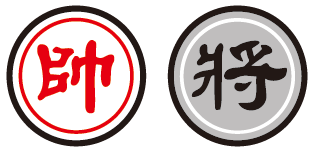
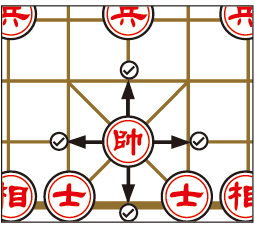
General “Shuài” 帥/帅 and “Jiàng” 將/将Generals may move one point either vertically or horizontally, but not diagonally and is confined to the nine points within his palace. A general may not also move into a file, which is occupied by the enemy general, unless there is at least one piece positioned between the generals in the file. |
|
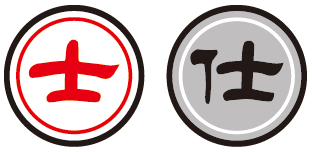
Guard / Advisor “Shì” 仕 and “Shì” 士These are the king’s counselors and guard the king within the palace. The guard moves one point diagonally and is confined to the palace.
|
|
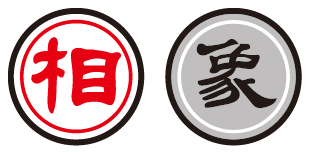
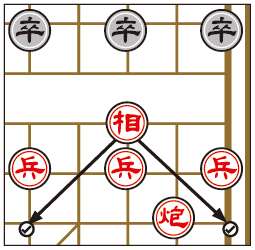
Elephant “Xiàng” 相 and “Xiàng” 象The elephants move exactly two points in any diagonal direction and may not jump over intervening pieces or cross the river. |
|
Horse “Mà” 傌/马 and “Mǎ” 馬/马The horse moves one point horizontally or vertically, and then one point diagonally. It cannot move in a direction where there is a piece blocking it along the path of movement. |
|
Chariot “Jū” 俥/车 and “Jū” 車/车Chariots move similarly to the rooks in international chess. The chariot moves as many points as it wishes horizontally or vertically. It cannot jump over pieces in its path. |
|
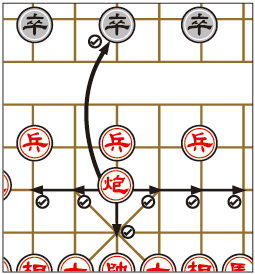
Cannons “Pào” 炮 and “Pào” 砲Cannons move exactly like the chariot. To capture, however, a cannon must jump over exactly one piece, friend or foe, along its line of movement. |
|
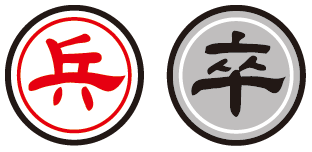
Soldier “Bīng” 兵 and “Zú” 卒Soldiers move and capture by advancing one point forward. Once a pawn has crossed the river it may also move and capture one point horizontally. A pawn may never move backward, thus retreating. |